

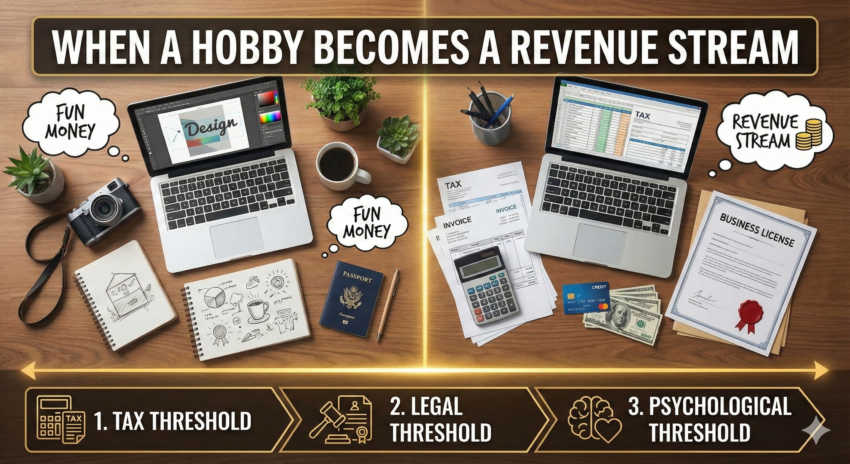
There is a certain peace in understanding where lines are drawn. As remote workers, we often celebrate the blurring of boundaries—between work and life, between countries, between the office and the beach. But there is one boundary that demands your respect: the threshold where a hobby becomes a business.
I have spent years studying migration documentation, and I can tell you this truth with certainty: governments across the world have established clear rules about when your creative side project stops being “fun money” and starts being taxable income. The problem is not that these rules are hidden. The problem is that most digital nomads never think to look for them until it is too late.
## The Three Thresholds You Must Understand
When your hobby generates revenue, you cross not one but three distinct thresholds—each with its own consequences.
### 1. The Tax Reporting Threshold
Every jurisdiction has a point at which income must be reported. In the United States, if you earn more than $400 in self-employment income, you must report it—even from selling handmade jewelry on Etsy or offering freelance photo editing. In Germany, the “Kleinunternehmerregelung” allows earnings up to €22,000 annually before VAT registration becomes mandatory. The United Kingdom sets its trading allowance at £1,000.
These numbers are not suggestions. They are legal obligations documented in official tax codes.
I spoke with a developer named Marcus who had been selling WordPress themes “on the side” while working remotely from Portugal. He earned approximately €8,000 over two years—money he considered pocket change from a hobby. When Portuguese tax authorities cross-referenced payment platform data, Marcus faced not only back taxes but penalties for failure to register as self-employed.
The lesson: document every euro, dollar, and pound from day one.
### 2. The Business Registration Threshold
Beyond tax reporting lies a second threshold: formal business licensing. This varies dramatically by location and activity type.
In Spain, if you regularly sell goods or services—even online, even to clients abroad—you may need to register as “autónomo” (self-employed). In Thailand, earning income while on a tourist visa violates immigration law regardless of amount. Estonia’s e-Residency program, conversely, was designed precisely to help location-independent entrepreneurs formalize their businesses with minimal bureaucracy.
The key word here is “regularly.” Selling your old camera once is not a business. Selling photography presets monthly is.
I maintain a checklist for this assessment:
– Is the activity recurring?
– Do you actively seek customers or clients?
– Have you invested money to improve the activity’s profitability?
– Do you present yourself publicly as offering this service?
If you answer “yes” to two or more, you have likely crossed from hobby to business in most jurisdictions.
### 3. The Psychological Threshold
My colleague Valery, who studies the emotional landscape of nomadic life, reminds me that there is a threshold no government form can capture: the moment when something you loved becomes something you must do.
I have seen this repeatedly in my research. A travel blogger who once wrote for joy now feels obligated to post. A musician who shared songs freely now calculates streaming revenue per track. The bureaucratic process of registering, invoicing, and reporting transforms the relationship between creator and creation.
This is not an argument against monetization. It is an argument for intentionality. Before you cross the legal thresholds, ask yourself: do I want this to become work?
## A Framework for Self-Assessment
Here is my recommended process, step by step:
**Step 1: Calculate your total hobby income over the past 12 months.**
Include all sources: direct sales, affiliate commissions, tips, sponsorships.
**Step 2: Identify your tax residency.**
This is often—but not always—where you spend the most time. Consult your country’s official tax authority website.
**Step 3: Research three specific numbers for your tax residency:**
– Income reporting threshold
– VAT/GST registration threshold
– Self-employment registration requirements
**Step 4: If you operate in multiple countries, repeat Step 3 for each.**
Permanent establishment rules may create tax obligations where you did not expect them.
**Step 5: Document everything.**
Keep receipts, invoices, and records of all transactions. This is not paranoia—it is protection.
## The Peace of Compliance
I understand that bureaucracy feels like the enemy of freedom. But I have learned, through years of navigating visa applications and residency permits, that compliance is actually a form of liberation. When your paperwork is in order, you sleep soundly. When you have registered correctly, no letter from a tax authority can ruin your morning coffee in Lisbon.
The threshold between hobby and business is not a trap. It is simply a door. And like all doors, it works best when you walk through it with your eyes open, documents in hand, knowing exactly where you stand.
If you are approaching any of these thresholds, I encourage you to consult official sources: your national tax authority’s website, your immigration status documentation, and if necessary, a qualified tax professional who understands cross-border income.
The forms are there. The rules are written. All that remains is for you to read them.