

Dear Fellow travelers of bureaucracy,
If you’ve ever stared at a stack of certificates — birth, diploma, marriage, police clearance — and wondered, ‘How do I make these valid in another country?’ you’re not alone. As a digital nomad, expat, or international professional, you’ve likely faced the silent, swirling vortex of international document legalization. But let me assure you: what appears as chaos is, in fact, a meticulously designed system. And today, I’ll guide you through it — calmly, step by step.
## The Hague Convention: Your Foundation of Order
At the heart of modern document legalization lies the 1961 Hague Convention Abolishing the Requirement of Legalization for Foreign Public Documents. In simple terms: if both your home country and your destination country are signatories (and 128 are), you don’t need a full embassy legalization. You need only one thing: an apostille.
An apostille is not a stamp. It’s not a translation. It’s a standardized certificate, attached to your original document, that verifies the authenticity of the signature, seal, or stamp of the issuing authority. Think of it as a global notary seal — recognized across borders.
> 📌 Source: [Hague Conference on Private International Law — Members & Status](https://www.hcch.net/en/instruments/conventions/status-table/?cid=41)
## The Apostille Chain: A Calm, Linear Path
Picture this as a chain. Each link is a single, verifiable step. Break one link? The chain breaks. Skip one? Rejection follows. But if you follow it… peace follows.
### Step 1: Obtain Your Original Document
Make sure your document is original, issued by a legitimate public authority (e.g., state registrar, university, court). Copies won’t suffice — unless they’re certified copies, which we’ll come to.
### Step 2: Authenticate with the Competent Authority
Each country designates a ‘Competent Authority’ to issue apostilles. In the U.S., it’s the Secretary of State in each state. In the UK, it’s the Foreign, Commonwealth & Development Office. In Japan, it’s the Ministry of Foreign Affairs.
> 💡 Pro Tip: Always check the official government website — not third-party providers — for the current authority and fees. For instance: [U.S. Department of State Apostille Page](https://travel.state.gov/content/travel/en/international-travel/while-abroad/legalization.html)
### Step 3: Verify Your Destination Country’s Rules
Here’s where patience becomes your greatest asset.
Some countries require an additional step: secondary legalization. This is where chains get complex.
### Country-Specific Quirks (The Quiet Exceptions)
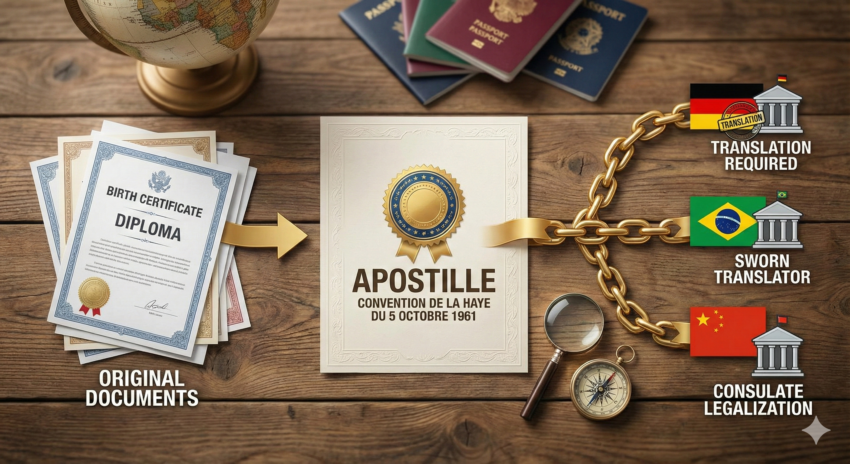
– **Germany**: Accepts apostilles without issue — but if your document is in English, they may require a certified translation *before* the apostille.
– **Brazil**: Requires the apostilled document to be translated *by a sworn translator registered in Brazil* — *after* apostille issuance.
– **China**: Accepts apostilles — but only if the document is translated and notarized by the Chinese embassy/consulate *after* the apostille. Yes, after. Not before.
– **India**: Does *not* recognize apostilles for all document types. For educational or marriage documents, you may need additional clearance from the Ministry of External Affairs in New Delhi.
> ✅ Always verify your destination’s requirements with their Ministry of Foreign Affairs or nearest embassy. A ten-minute phone call can save you two weeks.
### Step 4: The Visual Flowchart Concept (Mind Map)
Imagine a single path:
[Original Document] → [Issuing Authority: e.g., County Clerk] → [State Apostille Authority] → [Destination Country Requirements?] → [Certified Translation if Needed] → [Final Acceptance]
No detours. No shortcuts. Just clear, linear steps.
## Why 90% of Stress Disappears with Proper Preparation
We hear: “The paperwork is too much!” But in my 15 years advising expats, I’ve found that 90% of legalizations fail not because the system is broken — but because someone skipped a step, assumed language rules didn’t matter, or used a non-official service.
The magic? Preparation.
– Print two copies of every document before you start.
– Use a dedicated folder — digital and physical — with labels: ‘Apostille Done’, ‘Translation Pending’, ‘Approved’.
– Note deadlines: some documents (e.g., police clearances) expire in 3–6 months.
## Final Word: Bureaucracy Is a Puzzle — And You Are the Solver
I don’t see forms as barriers. I see them as maps. They don’t trap you. They guide you.
Next time you’re waiting for an apostille to arrive by mail, sipping tea with a quiet mind, remember: you’re not stuck in red tape. You’re threading together a global legal fabric — one authenticated document at a time.
The system works. You just have to follow it.
With patience, precision, and peace,
— Arturo “The Bureaucrat”
📌 Resources:
– Hague Convention Members: https://www.hcch.net
– U.S. State Department Apostille Guide: https://travel.state.gov
– EU Apostille Portal: https://ec.europa.eu/info/publications/apostille_en